UzhNU's experience in virtual exchanges

Since 2022, UzhNU has been actively implementing the COIL (Collaborative Online International Learning) model, a modern format of virtual academic mobility. This methodology is a key element of the “internationalization at home” strategy, which allows students and teachers to integrate into the global academic community without the need to physically cross borders. COIL combines synchronous and asynchronous learning formats, creating an inclusive and safe space for international cooperation. This approach allows participants from different countries to acquire practical skills in intercultural communication and effective teamwork.
In 2024, Diana Haidanka, Associate Professor of the Department of English Philology of the Faculty of Foreign Philology, successfully completed the training course “Basics of COIL Design and Facilitation.” As a result, she and Prof. Mary Ann Cohen (Indiana University, Indianapolis, USA) implemented the collaboration in the winter semester of 2025 by developing a joint mini-course “Professional English.” The aim of the course is to explore the role of cross-cultural communication in today's globalized business environment and to master the skills of self-presentation in a multicultural environment. On the Ukrainian side, second-year students of the English department participated in the project as part of the “Business Translation” course, and students from various courses at Indiana University who are studying “Business Correspondence” as an elective component. The students worked throughout the semester, meeting synchronously every two weeks in mini-teams in Zoom session rooms. According to D. Haidanka, “The project was implemented in an interesting, lively, and effective manner, proving once again that successful learning and further career growth are impossible without international cooperation.”

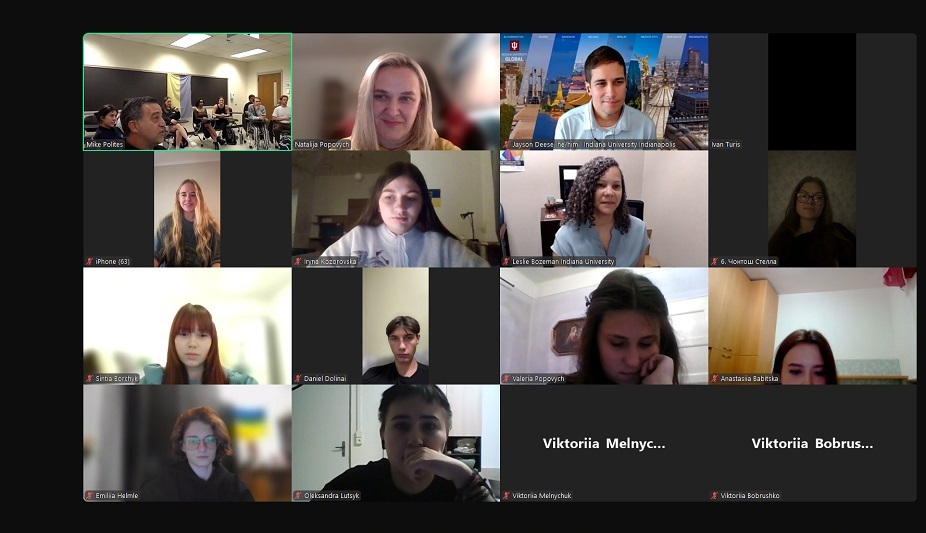
In 2024, Natalia Popovich, Associate Professor of the Department of Multicultural Education and Translation of the Faculty of History and International Relations, completed the “Fundamentals of COIL Design and Facilitation” training course together with Mike Polaites, a lecturer from the Department of Communication Studies of the Faculty of Humanities (Indiana University in Indianapolis, USA) and applied the COIL methodology in their disciplines during the winter semester: “Theory and Practice of Translation” (UzhNU) and “Humor and Communication” (Indiana University). Their COIL module “Overcoming Borders through Intercultural Communication and Cooperation” lasted 4 weeks (4 classes). Natalia Popovich comments: "Virtual exchanges should not be underestimated. They offer new perspectives in the context of the internationalization of education and science while preserving national identity, with the aim of overcoming borders and increasing accessibility for better results and greater opportunities for students and teachers. Such international practices are an example of a simple and accessible communication space where every member of the academic and scientific community of Ukrainian higher education institutions and higher education institutions of the partner country can enrich themselves both in terms of gaining experience and knowledge within the framework of an academic discipline or scientific research, and in terms of personal communication."
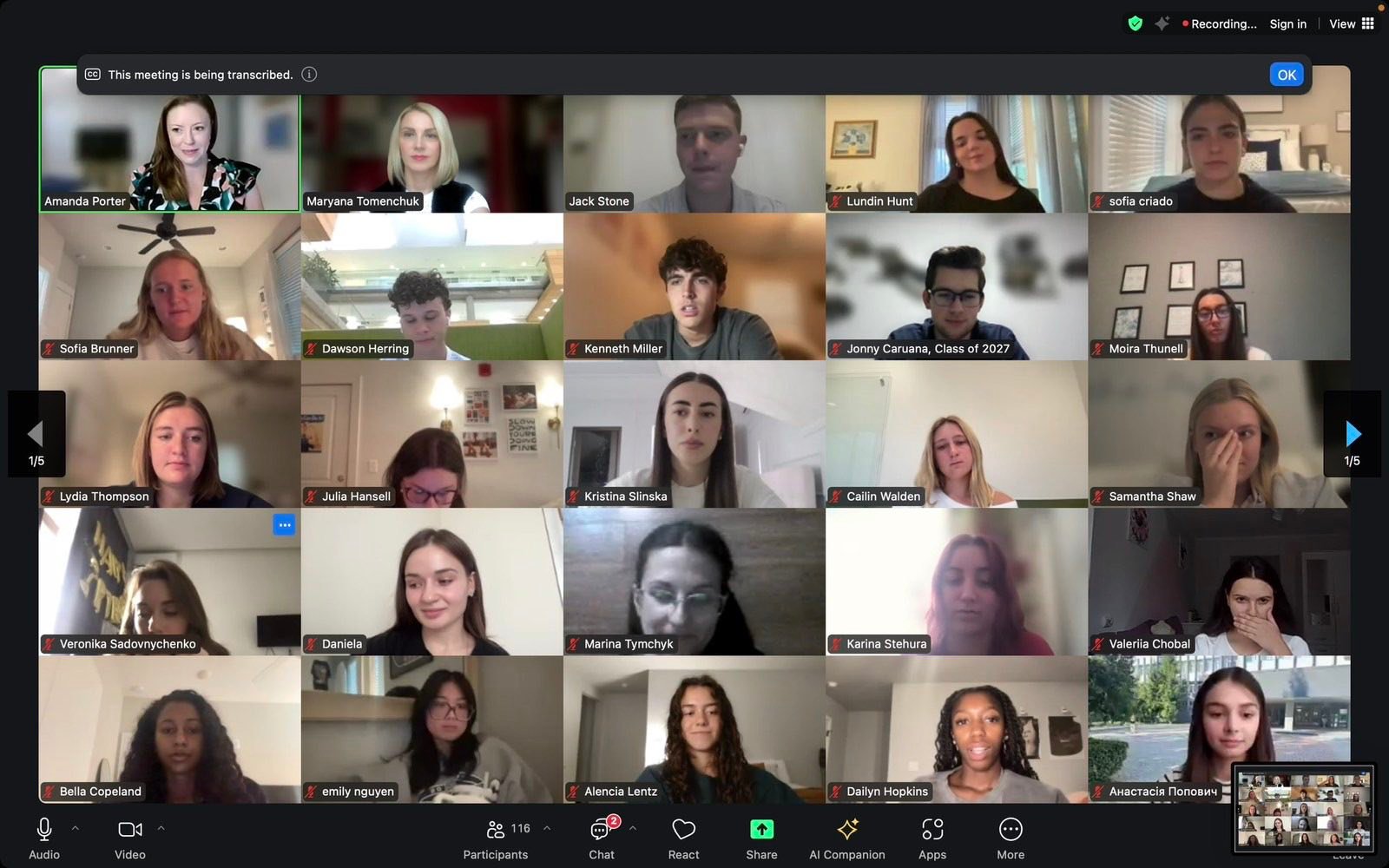
In 2025, Associate Professor of Applied Linguistics Mariana Tomenchuk and Hankamer Business School (Baylor University, USA) lecturer Dr. Amanda Porter participated in the “COIL Basics Workshop” and initiated a 7-week COIL project. American students from the Hankamer Business School who were studying Business English were involved, as were students from the Department of Applied Linguistics who were studying Business English and senior lecturer Marina Tymchik's students, mathematics students who were studying English for Career Growth (lecturer: Associate Professor Antonina Devitska). Maryna Tymchik, mathematics students who studied the discipline “English for Career Growth” (lecturer – Associate Professor Antonina Devitska). The students worked in 16 international teams, created start-up ideas, and at the end presented their final pitch projects. “I would especially like to emphasize the creativity, tolerance, and sincere interest of the students in working on the project,” notes M. Tomenchuk.
UzhNU continues its work in the field of virtual mobility with the co-founders of ALINCO (Alliance for Internationalization and Collaboration in Higher Education): Masaryk University (Czech Republic), Azua University (Ecuador), University College London (United Kingdom), Madre y Maestra Catholic University (Dominican Republic), Catholic University of Salta (Argentina), Erzincan Binali Yildirim University (Turkey), and the Gorlovka Institute of Foreign Languages of the Donbas State Pedagogical University.
In 2025, two epistemic projects were carried out with the participation of students from eight universities, coordinated by Antonina Bulina, Associate Professor of the Department of Applied Linguistics. The participants were mainly students from the Faculty of International Economic Relations. In the project “Futures and Transcultural Competence: The Black Menagerie,” which was carried out during the summer semester of 2025 and consisted of nine sessions, a team of students from UzhNU presented the topic “To Be Included.”
The following aspects were covered: key shifts in the interpretation of inclusion, challenges for societies regarding inclusion, inclusion during war, linguistic inclusion, cultural inclusion, and religious inclusion. The team also included one student from the Faculty of Medicine (specializing in Medicine).
During the winter semester of 2025, the “Power Cube” project was implemented, with a slightly modified format. Unlike previous years, when presentations were prepared by national teams and presented for international discussion, four international teams were now formed, each mentored by three different teachers from the participating universities. Each team consisted of students from eight universities, who were tasked with preparing a presentation on a given topic, creating a video trailer, and organizing a discussion in break-out rooms. The international teams worked on four topics: The Power of Machine Vision, Power of Language, English as a Post-Colonial Issue, and Power across History.
.
 Students developed their presentation skills in a context of cultural diversity and intercultural communication by preparing presentations, moderating discussions in Zoom rooms, and considering cultural and global issues. Participants researched and analyzed, gave public speeches, worked in teams, learning to facilitate, chair, report, and summarize information.

Also during the winter semester, students of the Applied Linguistics program joined another project, “Masters and Living Crafts,” coordinated by the Moravian Regional Museum in Brno, Czech Republic, in cooperation with ALINCO partners and implemented as part of their respective academic initiatives. In particular, students had the opportunity to conduct an interview using a provided questionnaire with master Maria Chorii from Velykyi Bychkiv, Zakarpattia, who bakes honey cakes, analyze it, and present it to the international community. It should be noted that this international research project aims to map crafts and craft activities in the long term, with an emphasis on their significance as bearers of tradition, identity, and cultural content at both the local and regional levels. An international catalog is being prepared for publication, which will feature the master's work alongside the work of masters from different countries. Thus, the importance of the ability to perform real tasks becomes apparent to the student: an advantage for the employer, overcoming fear (the “impostor syndrome” and fear of the first job disappear, professional confidence emerges), a ready portfolio (real tasks become case studies that can be shown at an interview as proof of competence), understanding of the profession (a test drive of future work: students understand whether this field is right for them and what skills they need to improve. In fact, the student transforms from a “theorist” to a “practitioner.” Based on these three projects, three articles are being prepared in collaboration with the participating universities.