Faculty members of the Department of Journalism are developing a course on the use of AI in the media in collaboration with colleagues from Sweden

The Department of Journalism at Uzhhorod University is launching a new international project titled “Building Resilience, Integrity, and Digital Development in Journalism Education” (BRIDGE-Ukraine). The project aims to strengthen the capacity of Ukrainian journalism education amid the war, technological challenges, and information threats.
The project is being implemented as part of the Norwegian-Ukrainian partnership program “Nansen EDU – Norwegian–Ukrainian Cooperation in Higher Education.” The Norwegian University College NLA (NLA Høgskolen) serves as the applicant and coordinator of the initiative. The consortium brings together five leading Ukrainian universities: Taras Shevchenko National University of Kyiv (Institute of Journalism), Borys Grinchenko Kyiv Metropolitan University, Sumy State University, the relocated Mariupol State University, and Uzhhorod University, as well as the Swedish media institute “Fojo” (Linnaeus University). The project is also supported by the European Association for Journalism Training (EJTA), the Commission on Journalism Ethics (KZHE), and the National Union of Journalists of Ukraine (NSJU).
The partners aim to strengthen the capacity of journalism education programs in Ukraine by carrying out the following tasks: developing and teaching new courses on the responsible use of artificial intelligence in journalism and a course on entrepreneurship for future media professionals; training journalism instructors in the use of digital teaching tools; providing psychosocial support to staff and students; conducting supporting research on journalism education in Ukraine.
The Department of Journalism at UzhNU, in collaboration with the Swedish media institute “Fojo,” will work on a project package dedicated to the creation and implementation of the course “Responsible Use of Artificial Intelligence in Journalism.” They plan to develop two versions: one for students and the other for practicing journalists. Currently, UzhNU is one of two partners that already has a foundation of work in this field; however, the rapid development of technology requires significant updates to these materials. The new 4-ECTS-credit course will be an elective for upper-level undergraduate students and will cover topics such as the ethics of artificial intelligence, data analysis, and combating disinformation.
Project participants will also develop and deliver a specialized AI certification program for media professionals in the region, which will help strengthen ties between the academic community and practitioners.
The Swedish media institute “Fojo” has extensive experience in training media professionals; it previously developed an AI course for journalists and plans to refine it in collaboration with colleagues from UzhNU.
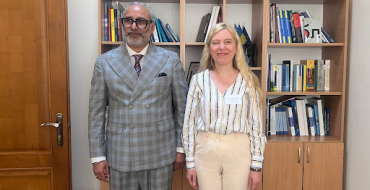
On June 25, partners from UzhNU and the Swedish “Fojo” held their first working meeting, during which they discussed the topics for the course modules on the use of AI in journalism. In particular, Veronika Menzhun, manager of international programs at Fojo and director of programs in Europe and the Caucasus, shared her experience teaching an AI course for practicing journalists. Professor Yurii Bidzilia, dean of the Faculty of Philology, along with associate professors Halyna Shapovalova and Vasyl Sharkan, discussed the specifics of such a course for students in the journalism department at UzhNU. Also participating in the meeting were Yevhen Solomin, head of the Department of Journalism; senior lecturer Vasyl Putrashyk; and associate professor Nataliya Tolochko. UzhNU students shared their ideas on the course content, particularly emphasizing the importance of topics such as AI and disinformation, the use of AI in newsrooms and investigative journalism, and discussed the possibility of inviting practicing journalists from abroad to teach specific topics.
As part of the project, Uzhhorod was selected as the venue for a large-scale, three-day consultative meeting of journalism instructors from Ukraine titled “Ukrainian Journalism Instructor: Transition to Digital Technologies.” The event will involve the creation of a practical guide on digital pedagogy and the organization of a series of seminars.
In addition, during the project’s third year, the partners will hold a three-day academic and practical conference on the challenges of journalism education in wartime.
All educational materials developed by BRIDGE-Ukraine participants will be integrated into the journalism curriculum at Uzhhorod National University and will also be made available to other Ukrainian universities. Participation in the project will improve the quality of training for future media professionals, strengthen the regional media landscape’s resilience to disinformation, and promote the further integration of Ukrainian education into the European research area.